FreeRTOS 中的数据结构——列表与列表项
列表和列表项是直接从 FreeRTOS 源码的注释中的list和list item翻译过来的,对应 C 语言中的链表和节点,在后续的讲解中,我们说的链表就是列表,节点就是列表项。
List→ 链表List Item→ 节点
链表分为单向链表和双向链表,单向链表很少使用,用得最多的还是双向链表。
定义 List Item
struct xLIST_ITEM
{
    TickType_t xItemValue;             /* auxiliary value,  Help nodes to arrange in order */
    struct xLIST_ITEM * pxNext;
    struct xLIST_ITEM * pxPrevious;
    void * pvOwner;                    /* point to the kernel object that owns the node, usually TCB */
    void * pvContainer;                /* point to linklist where the node is located */
};
typedef struct xLIST_ITEM ListItem_t;  /* redefinition of node data type */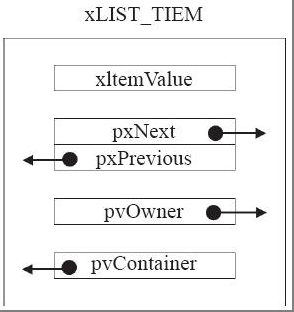
初始化 List Item
void vListInitializeItem(ListItem_t * const pxItem)
{
    /* Initializing the node is empty, which means that the node has not inserted any linked list. */
    pxItem->pvContainer = NULL;
}
初始化 List Item 时只需要将pvContainer初始化为空即可,表示该 Item 还没有插入任何链表。
定义 List
typedef struct xLIST
{
    UBaseType_t uxNumberOfItems;
    ListItem_t * pxIndex;
    MiniListItem_t xListEnd;
} List_t;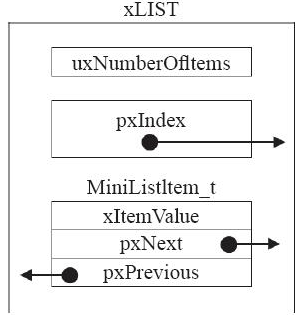
哨兵节点
struct xMINI_LIST_ITEM
{
    TickType_t xItemValue;
    struct xLIST_ITEM * pxNext;
    struct xLIST_ITEM * pxPrevious;
};
typedef struct xMINI_LIST_ITEM MiniListItem_t;
List 初始化
void vListInitialize(List_t * const pxList)
{
    /* Point the linked list index pointer to the last node. */
    pxList->pxIndex = ( ListItem_t * ) &( pxList->xListEnd );

    /* Set the auxiliary sorting value of the last node of the linked list to the maximum to ensure that this node is the last node of the linked list. */
    pxList->xListEnd.xItemValue = portMAX_DELAY;

    /* Pointing the pxNext and pxPrevious pointers of the last node to the node itself indicates that the linked list is empty. */
    pxList->xListEnd.pxNext = ( ListItem_t * ) &( pxList->xListEnd );
    pxList->xListEnd.pxPrevious = ( ListItem_t * ) &( pxList->xListEnd );

    /* The value of the initialization linked list node counter is 0, indicating that the linked list is empty. */
    pxList->uxNumberOfItems = ( UBaseType_t ) 0U;
}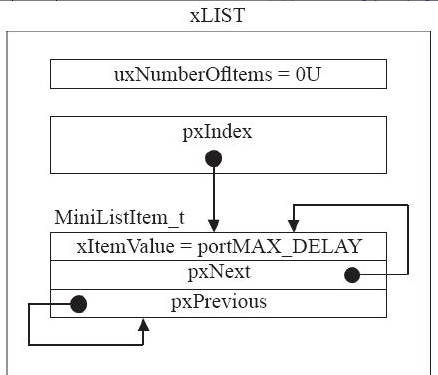
- List 初始化时,将
pxIndex指向最后一个元素,即第1个,或者第0个,因为这个元素不会计入计数器。 - 将哨兵元素的辅助排序值
xItemValue设置为最大,确保该元素就是最后一个(也可以理解为第一个)。 - 将最后一个(第一个)的
pxNext和pxPrevious均指向自身,表示 List 为空。 - 初始化
uxNumberOfItems为0,表示 List 为空。
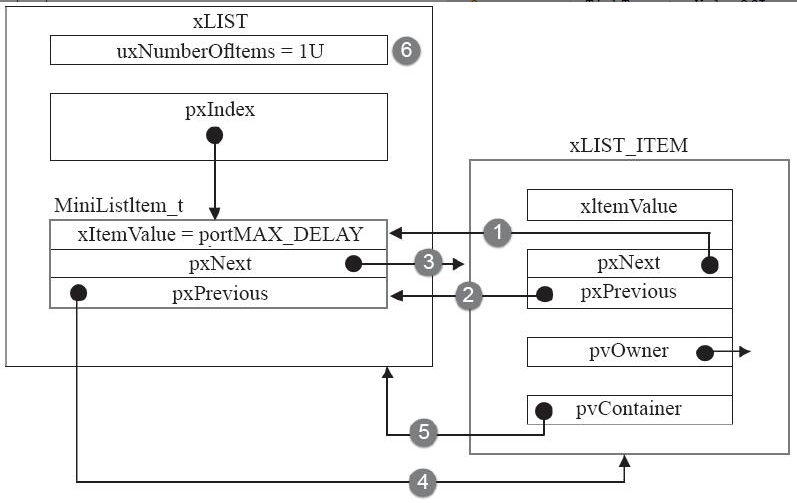
将 Item 插入 List 尾部
void vListInsertEnd(List_t * const pxList, ListItem_t * const pxNewListItem)
{
    ListItem_t * const pxIndex = pxList->pxIndex;

    pxNewListItem->pxNext = pxIndex;
    pxNewListItem->pxPrevious = pxIndex->pxPrevious;
    pxIndex->pxPrevious->pxNext = pxNewListItem;
    pxIndex->pxPrevious = pxNewListItem;

    /* Remember the linked list where the node is located. */
    pxNewListItem->pvContainer = (void *) pxList;

    /* Linked list node counter */
    (pxList->uxNumberOfItems)++;
}
这里有两个地方,我之前没弄明白。
第一个是ListItem_t * const pxIndex = pxList->pxIndex;,图中给了误导,让我以为这里的 pxIndex是图片中所标识的pxIndex,但不是同一个,代码中的 pxIndex是在这个函数内部新定义的一个局部指针变量,不是从外面传进来的,也不是“新建一块内存”。它只是“新建了一个指针变量”,然后把 pxList->pxIndex 里的地址拷贝了一份给它。
ListItem_t * const pxIndex = pxList->pxIndex;可以分成两部分理解:
ListItem_t * const pxIndex;在栈上定义了一个名叫pxIndex的局部变量,类型是 “指向ListItem_t的常量指针”。- “常量指针(
* const)” 的意思是:指针本身的值(指向哪个地址)不能再改,但它指向的那个对象的内容是可以改的。
- “常量指针(
= pxList->pxIndex;把pxList这个List_t结构体中的成员pxIndex(也是一个指针)的值,拷贝给 这个局部变量pxIndex。
所以:pxIndex不是 一个新的节点,也没有 申请新的内存。- 它只是一个新的“别名指针”,指向和
pxList->pxIndex同一个节点。
第二个是
pxIndex->pxPrevious->pxNext = pxNewListItem;
pxIndex->pxPrevious = pxNewListItem;
也是被图片误导了,其实是理解偏差,图片表示的是 List 中只有一个哨兵节点,在这种情况下,pxNext和pxPrevious都指向自己,所以我单纯的以为pxIndex->pxPrevious就是pxIndex,那么pxIndex->pxPrevious->pxNext就是pxIndex->pxNext。
但是,当 List 非空,pxIndex->pxNext 和 pxIndex->pxPrevious->pxNext 不是同一个指针成员,也不一定指向同一个节点。
将 Item 按照升序插入 List
void vListInsert(List_t * const pxList, ListItem_t * const pxNewListItem)
{
    ListItem_t *pxIterator;

    const TickType_t xValueOfInsertion = pxNewListItem->xItemValue;

    if(xValueOfInsertion == portMAX_DELAY)
    {
        pxIterator = pxList->xListEnd.pxPrevious;
    }
    else
    {
        for( pxIterator = (ListItem_t *) & (pxList->xListEnd);
                pxIterator->pxNext->xItemValue <= xValueOfInsertion;
                pxIterator = pxIterator->pxNext )
        {
            /* Do nothing, and keep iterating to find the position where the node is to be inserted. */
        }
    }

    /* Insert nodes according to ascending order. */
    pxNewListItem->pxNext = pxIterator->pxNext;
    pxNewListItem->pxNext->pxPrevious = pxNewListItem;
    pxNewListItem->pxPrevious = pxIterator;
    pxIterator->pxNext = pxNewListItem;

    /* Remember the linked list where the node is located. */
    pxNewListItem->pvContainer = (void * )pxList;

    (pxList->uxNumberOfItems)++;
}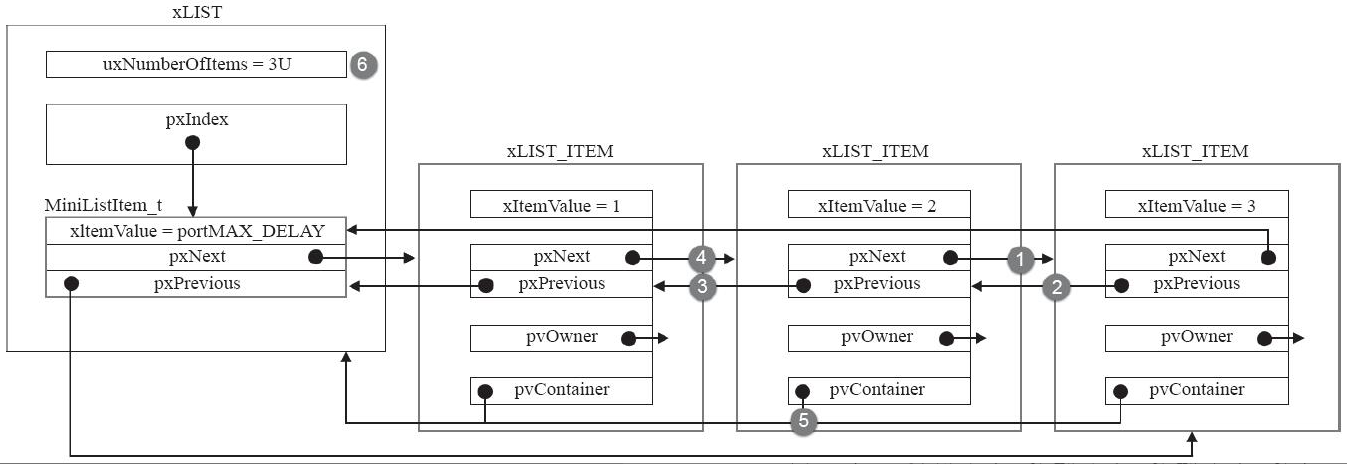
这里的重点是理解for循环
for( pxIterator = (ListItem_t *) & (pxList->xListEnd);
                pxIterator->pxNext->xItemValue <= xValueOfInsertion;
                pxIterator = pxIterator->pxNext )
        {
            /* Do nothing, and keep iterating to find the position where the node is to be inserted. */
}通过循环找到要插入的位置,后面就是各个Item指针指向的更新。
将 Item 从 List 中删除
UBaseType_t uxListRemove(ListItem_t * const pxItemToRemove)
{
    /* Get the linked list where the node is located. */
    List_t * const pxList = (List_t *) pxItemToRemove->pvContainer;

    /* Delete the specified node from the linked list.  */
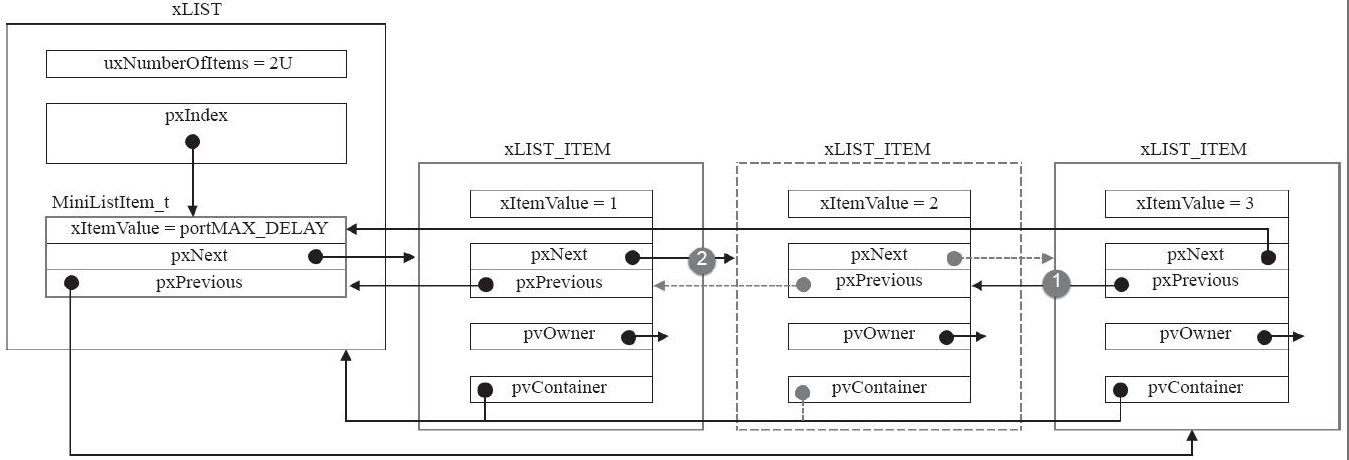
    pxItemToRemove->pxNext->pxPrevious = pxItemToRemove->pxPrevious;
    pxItemToRemove->pxPrevious->pxNext = pxItemToRemove->pxNext;

    /* Adjust the node index pointer of the linked list */
    if(pxList->pxIndex == pxItemToRemove)
    {
        pxList->pxIndex = pxItemToRemove->pxPrevious;
    }

    /* The linked list where the node is initialized is empty, which means that the node has not inserted any linked list. */
    pxItemToRemove->pvContainer = NULL;

    (pxList->uxNumberOfItems)--;

    /* Returns the number of remaining nodes in the linked list. */
    return pxList->uxNumberOfItems;
}
下面我把 FreeRTOS 链表的三个核心操作,从头到尾给你做一个 “总复盘”。你已经自己做过实验和画图了,这里主要是把关键概念 + 指针套路系统整理一下,方便你以后一眼就能看懂源码。
0. 基本结构与整体设计
0.1 结构体
typedef struct xLIST_ITEM
{
    TickType_t xItemValue;
    struct xLIST_ITEM * pxNext;
    struct xLIST_ITEM * pxPrevious;
    void * pvOwner;
    void * pvContainer;   /* 指向所属 List_t */
} ListItem_t;

typedef struct xMINI_LIST_ITEM
{
    TickType_t xItemValue;
    struct xLIST_ITEM * pxNext;
    struct xLIST_ITEM * pxPrevious;
} MiniListItem_t;

typedef struct xLIST
{
    UBaseType_t uxNumberOfItems;
    ListItem_t * pxIndex;     /* 遍历用的当前指针 */
    MiniListItem_t xListEnd;  /* 哨兵结点 */
} List_t;
0.2 关键设计点
双向循环链表
- 每个节点有
pxNext/pxPrevious。 - 最后一个节点的
pxNext指向xListEnd; - 第一个节点的
pxPrevious指向xListEnd; xListEnd的pxNext是“第一个节点”,pxPrevious是“最后一个节点”。
- 每个节点有
哨兵节点
xListEnd(MiniListItem_t)- 永远在链里,不计入
uxNumberOfItems。 xListEnd.xItemValue = portMAX_DELAY(最大值),保证排序逻辑简单。
- 永远在链里,不计入
每个 ListItem 记录所属链表
listItem->pvContainer = pxList;  // 插入时设置
listItem->pvContainer = NULL;    // 删除/初始化时清空
这样
uxListRemove()不需要搜索,就能直接拿到List_t。pxIndex只是“遍历游标”- 有些 API(如获取下一个就绪任务)会用
pxList->pxIndex在环里绕圈。 - 删除时如果删到它,就把它挪到前一个节点,保持遍历安全。
- 有些 API(如获取下一个就绪任务)会用
1. 初始化:vListInitialise() & vListInitialiseItem()
1.1 初始化 List_t
核心逻辑(省略无关代码):
void vListInitialise( List_t * const pxList )
{
    pxList->uxNumberOfItems = 0U;

    pxList->xListEnd.xItemValue = portMAX_DELAY;

    pxList->xListEnd.pxNext     = ( ListItem_t * ) &( pxList->xListEnd );
    pxList->xListEnd.pxPrevious = ( ListItem_t * ) &( pxList->xListEnd );

    pxList->pxIndex = ( ListItem_t * ) &( pxList->xListEnd );
}结果:只有一个哨兵节点自环:
xListEnd.pxNext     -> xListEnd
xListEnd.pxPrevious -> xListEnd
uxNumberOfItems     = 0
pxIndex             = &xListEnd
1.2 初始化 ListItem_t
void vListInitialiseItem( ListItem_t * const pxItem )
{
    pxItem->pvContainer = NULL;
}- 表示:这个节点当前不在任何链表中。
2. 无序尾插:vListInsertEnd()
语义:把新节点插到“末尾”——也就是 xListEnd 的前面。
本质上插入到:
oldLast <-> xListEnd之间,成为新的 oldLast;xListEnd 永远在最后。
关键代码:
void vListInsertEnd( List_t * const pxList, ListItem_t * const pxNewListItem )
{
    ListItem_t * const pxIndex = pxList->pxIndex;  // 通常是 &xListEnd

    pxNewListItem->pxNext     = pxIndex;
    pxNewListItem->pxPrevious = pxIndex->pxPrevious;

    pxIndex->pxPrevious->pxNext = pxNewListItem;
    pxIndex->pxPrevious         = pxNewListItem;

    pxNewListItem->pvContainer  = ( void * ) pxList;
    ( pxList->uxNumberOfItems )++;
}
理解方式(假设 pxIndex == &xListEnd):
pxNewListItem->pxNext = pxIndex;
→ 新节点的next指向xListEnd。pxNewListItem->pxPrevious = pxIndex->pxPrevious;
→ 新节点的previous指向“旧的最后一个节点”(oldLast)。pxIndex->pxPrevious->pxNext = pxNewListItem;
→oldLast->next = new,让旧尾的next指向新节点。pxIndex->pxPrevious = pxNewListItem;
→xListEnd->previous = new,更新“谁是新的最后一个”。
你之前已经弄明白的关键点:
pxIndex->pxNext和pxIndex->pxPrevious->pxNext不是一回事。
这里要改的是旧尾结点的next,所以必须用pxIndex->pxPrevious->pxNext。
3. 有序插入:vListInsert()
目标:按 xItemValue 升序,把新节点插入到合适位置,保持链表一直有序。
3.1 先确定插入位置 pxIterator
const TickType_t xValueOfInsertion = pxNewListItem->xItemValue;

if( xValueOfInsertion == portMAX_DELAY )
{
    // 特殊值:直接插在“当前最后一个节点”之后
    pxIterator = pxList->xListEnd.pxPrevious;
}
else
{
    for( pxIterator = ( ListItem_t * ) &( pxList->xListEnd );
         pxIterator->pxNext->xItemValue <= xValueOfInsertion;
         pxIterator = pxIterator->pxNext )
    {
        /* 空循环,只是往前走 */
    }
}- 从
xListEnd开始,每次看pxIterator->pxNext->xItemValue。 - 只要“下一个节点的值 <= 新节点的值”,就继续往前走。
循环结束时,满足:
pxIterator->pxNext->xItemValue > xValueOfInsertion;此时:
- 左边节点 =
pxIterator - 右边节点 =
pxIterator->pxNext
→ 新节点应该插在这两个之间。
- 左边节点 =
3.2 再做和插入尾部几乎一样的 4 步
pxNewListItem->pxNext                = pxIterator->pxNext;
pxNewListItem->pxNext->pxPrevious    = pxNewListItem;
pxNewListItem->pxPrevious            = pxIterator;
pxIterator->pxNext                   = pxNewListItem;

pxNewListItem->pvContainer           = ( void * ) pxList;
( pxList->uxNumberOfItems )++;
对应关系:
... <-> pxIterator <-> oldNext <-> ...
变成
... <-> pxIterator <-> newItem <-> oldNext <-> ...
和 vListInsertEnd() 的指针套路是同一个模板,只是“基准节点”从 pxIndex 换成了搜索出来的 pxIterator。
4. 删除:uxListRemove()
语义:从所在链表中摘掉这个节点,保持链表结构仍然是一个完整的双向循环环。
4.1 找到所属链表
List_t * const pxList = ( List_t * ) pxItemToRemove->pvContainer;- 插入时我们设置过
pvContainer。 - 这里直接拿到对应的
List_t,不需要搜索。
4.2 双向断开中间节点
pxItemToRemove->pxNext->pxPrevious = pxItemToRemove->pxPrevious;
pxItemToRemove->pxPrevious->pxNext = pxItemToRemove->pxNext;
设:
prev = pxItemToRemove->pxPrevious;
next = pxItemToRemove->pxNext;
则这两行就是:
next->pxPrevious = prev;  // 右 ↤ 左
prev->pxNext     = next;  // 左 ↦ 右
前后连起来:
... <-> prev <-> itemToRemove <-> next <-> ...
变成
... <-> prev <-> next <-> ...
这正好是插入时那 4 步的“反向操作”。
无论中间节点是第一个、最后一个,还是唯一一个,这两行都正确成立,因为:
- 如果删的是第一个真实节点,
prev就是xListEnd; - 如果删的是最后一个真实节点,
next就是xListEnd; - 如果删的是唯一一个真实节点,
prev == next == xListEnd,
最终恢复到只有一个自环哨兵的状态。
4.3 调整 pxIndex(遍历安全)
if( pxList->pxIndex == pxItemToRemove )
{
    pxList->pxIndex = pxItemToRemove->pxPrevious;
}
如果当前遍历指针正好指向被删的节点,就把它退回到
prev:- 这个
prev一定还在链里(可能是xListEnd); - 下一次从它继续往前遍历,不会漏、不访问野指针。
- 这个
4.4 解除节点与链表的关系 & 更新计数
pxItemToRemove->pvContainer = NULL;
( pxList->uxNumberOfItems )--;

return pxList->uxNumberOfItems;
pvContainer = NULL:标记“这个节点现在不在任何链表中”。uxNumberOfItems——只统计真实节点数,不包含哨兵。
5. 一个完整的例子串起来看
假设:
- 初始化一个空链表
list; - 初始化 3 个节点
i1, i2, i3,值分别为 2、1、3; - 用
vListInsert(&list, &i1/i2/i3)依次插入; - 用
uxListRemove(&i2)删除值为 1 的节点。
5.1 插入之后(有序)
插入顺序:2 → 1 → 3
最终链表(从 xListEnd.pxNext 向前):
xListEnd -> (1) -> (2) -> (3) -> xListEnd
uxNumberOfItems = 3
5.2 删除节点 (1)
pxItemToRemove = &i2 (xItemValue = 1):
prev = xListEndnext = 节点 (2)
两句删除指针:
next->pxPrevious = prev;   // (2).prev = xListEnd
prev->pxNext     = next;   // xListEnd.next = (2)
结果:
xListEnd -> (2) -> (3) -> xListEnd
uxNumberOfItems = 2
i2.pvContainer = NULL
如果此时 pxIndex 本来正好指向 i2,就被调整为 xListEnd。
评论已关闭